All Saints’ Church
Back to all places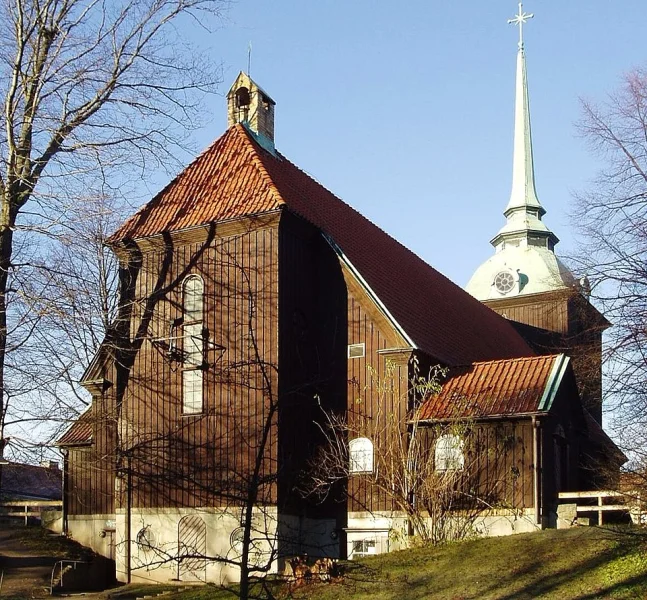
All Saints’ Church
0:00 / 3:18All Saints’ Church
Situated in the tranquil Helgalunden area of Södermalm, at the heart of Stockholm, Allhelgonakyrkan—or All Saints Church—stands as a testament to early 20th-century ecclesiastical architecture in Sweden. Established on a site granted by the City of Stockholm in the mid-1910s, the church emerged during a period of rapid urbanization when spiritual needs often lagged behind population growth. Construction commenced in 1917 following concerted efforts by the Society for the Promotion of Church Pastoral Care and priest Viktor Södergren, who were concerned by the lack of nearby houses of worship. Drawing inspiration from rural Swedish churches of the 18th century, architect Joel Norborg designed the church in wood, envisioning it as a temporary structure to be replaced by a more permanent stone edifice—a plan that ultimately shifted as the congregational community grew attached to their church.
Allhelgonakyrkan was officially consecrated on April 28, 1918, by the influential Archbishop Nathan Söderblom, who also bequeathed the church its name. The building was initially managed by the founding society and leased to Katarina parish, a relationship that proved complex and shifted in 1929 when the parish declined ownership and withdrew operating support. Faced with potential closure, a groundswell of parishioner support led to the establishment of the Friends of All Saints Church association in 1930. This dedicated group ensured the continuity of worship and maintenance, eventually taking official ownership in 1958 before handing the church over to the Katarina parish in 1972. Over the decades, Allhelgonakyrkan has undergone vital repairs and alterations: 1927 saw new floors and joists installed to combat fungal infestation; in 1937, the original pine spire coverings were replaced with copper, and a new roof was constructed in 1948. These maintenance efforts have preserved the church’s distinctive brown-paneled exterior, square tower crowned with a copper-topped spire and cross, and intimate, north-south oriented nave.
The church’s interior features important artistic contributions, notably ceiling and wall decorations by Filip Månsson and a radiant choir window symbolizing the Trinity. The altarpiece, a 1960 triptych by Erik Abrahamson, masterfully depicts the risen Christ amid the city’s saintly patrons. The wooden pulpit, richly painted with apostolic motifs and completed with a colorfully adorned sound canopy in 1961, enhances the sacred atmosphere. Additional liturgical furnishings include a wooden baptismal font with elaborate carving and a brass basin, as well as two historically significant bells acquired and dedicated in 1931—the former once on loan from Sophiahemmet hospital.
Allhelgonakyrkan is renowned in contemporary Swedish church life for initiating the popular "All Saints’ Day Mass" in 1997, an event led by priest Olle Carlsson that continues to draw large congregations each autumn. The church thus offers a rich chronicle of faith, community action, and architectural heritage, making it a captivating destination for history enthusiasts and visitors fascinated by Stockholm’s ecclesiastical past.
59.30983, 18.07070