Observatory
Back to all places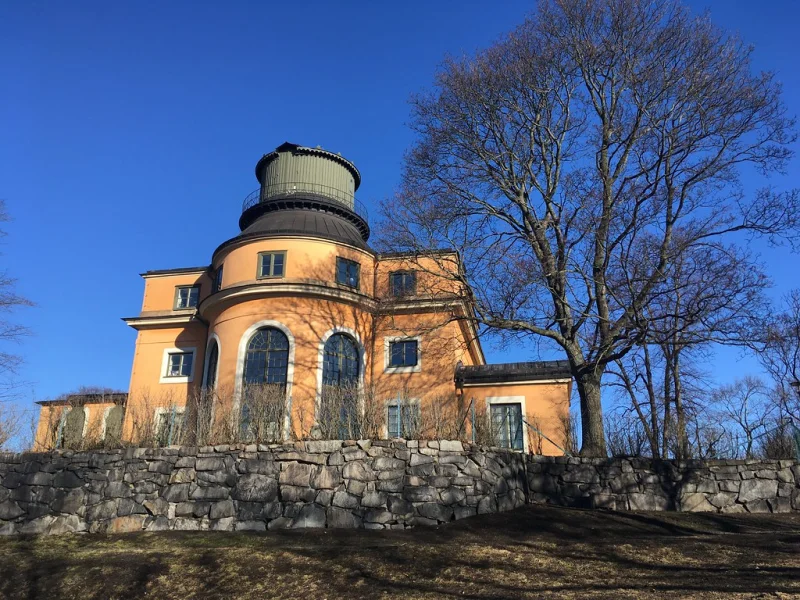
Observatory
0:00 / 1:35Observatory
Established in 1753, the Stockholm Observatory stands as a testament to Sweden’s pivotal contributions to the advancement of astronomical sciences. Originally situated on Observatoriekullen (Observatory Hill) in central Stockholm, this historic institution was one of the foremost observatories in northern Europe during the 18th and 19th centuries.
The building itself, a striking example of neoclassical architecture, was designed by renowned architect Carl Hårleman. Within its walls, groundbreaking measurements of celestial bodies and innovative meteorological observations were conducted, including the famous meridian arc measurements by Anders Celsius, who also devised the Celsius temperature scale here in the 1740s. During the late 19th century, the observatory became a hub for international scientific collaboration, notably participating in the global “Carte du Ciel” project, which aimed to chart the entire night sky. The site also played an instrumental role in timekeeping and navigation, contributing valuable astronomical data to mariners and travelers throughout Sweden and Europe. In 1931, the astronomical department moved to a new facility in Saltsjöbaden, signaling a new chapter for Swedish astronomy.
Today, the original observatory serves as a museum and educational center, preserving rare astronomical instruments and historical documents. Its storied past and commitment to scientific excellence make it a landmark of national and scientific heritage, attracting scholars and visitors keen to explore the history and impact of astronomy in Sweden and beyond.
59.34151, 18.05439