Saint Jacob’s Church
Back to all places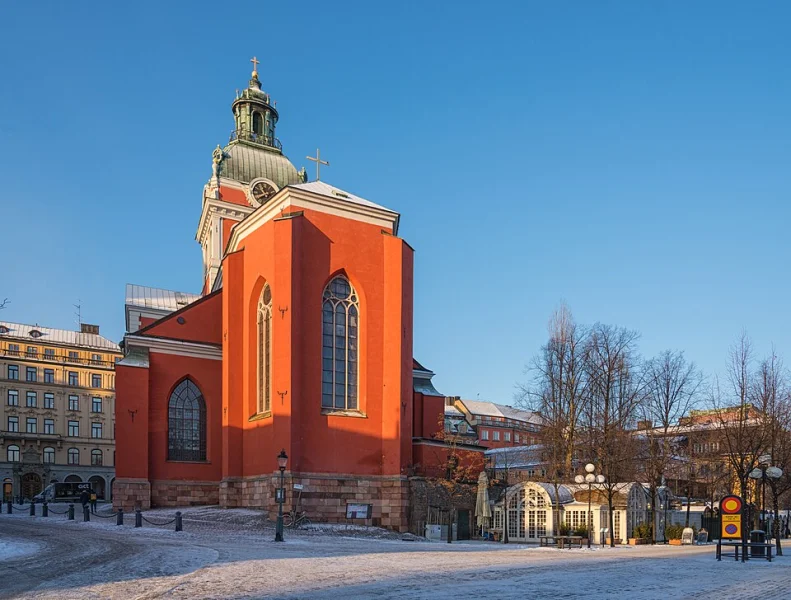
Saint Jacob’s Church
0:00 / 1:44Saint Jacob’s Church
Saint Jacob’s Church, located in central Stockholm near Kungsträdgården, stands as a vivid testament to Sweden’s rich religious and architectural history.
The first record of a church on this site dates back to the 14th century, but the present structure began construction in 1588 under the reign of King John III. Its completion spanned nearly a century, finally consecrated in 1643, a delay in part due to the political and religious turbulence of the time, including the Reformation and the Thirty Years’ War.
The church’s striking Dutch Renaissance style is attributed to leading architects such as Willem Boy and later Nicodemus Tessin the Elder, whose decorative and structural contributions are still admired today. Central to its history, Saint Jacob’s is named for Saint James the Greater, the patron saint of pilgrims — a homage reflected in intricate sculptures and motifs throughout the interior.
The church has borne witness to numerous historical milestones, including serving as a welcome refuge during the Great Northern War and the many plague outbreaks that swept through Stockholm in the 17th and 18th centuries. It played a role in Sweden’s Age of Liberty, hosting civic ceremonies and royal events. The main organ, one of Northern Europe’s largest, was installed in 1905, further enriching the vibrant cultural and musical life of the congregation. Over centuries, Saint Jacob’s Church has undergone several restorations, most notably in the late 19th century under the guidance of architect Helgo Zettervall, who revitalized its façade and interior.
Today, it remains a vital landmark in Stockholm, celebrated not only for its magnificent architecture but also for its continuous role at the heart of the city’s spiritual and cultural heritage.
59.33040, 18.07041